How to wear a beard mask?
Proper use supports hygienic production
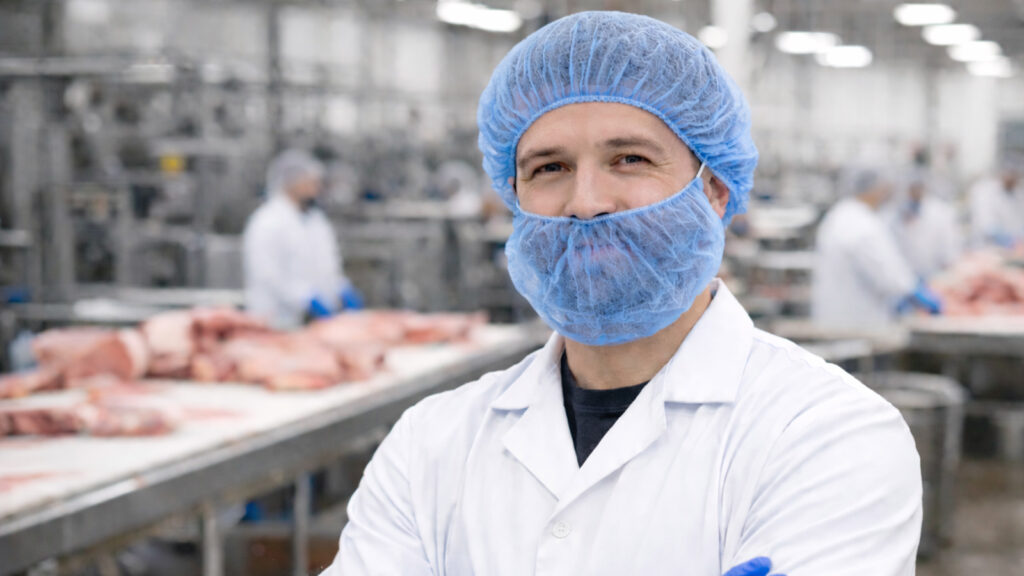
Beard masks play an important role in personal hygiene in environments where food safety, product purity, or infection prevention are essential. Wearing a beard mask correctly prevents beard or moustache hairs from coming into contact with products, machinery, or sensitive surfaces. This protects not only the production process but also the company’s reputation.
In this article, you will read how to wear a beard mask correctly, why this is essential in the food industry and other hygiene-sensitive environments, and which points of attention contribute to food-safe and hygienic working in line with HACCP guidelines. Proper use of food grade disposables and personal protective equipment (PPE) plays a central role in this.
Types of beard masks
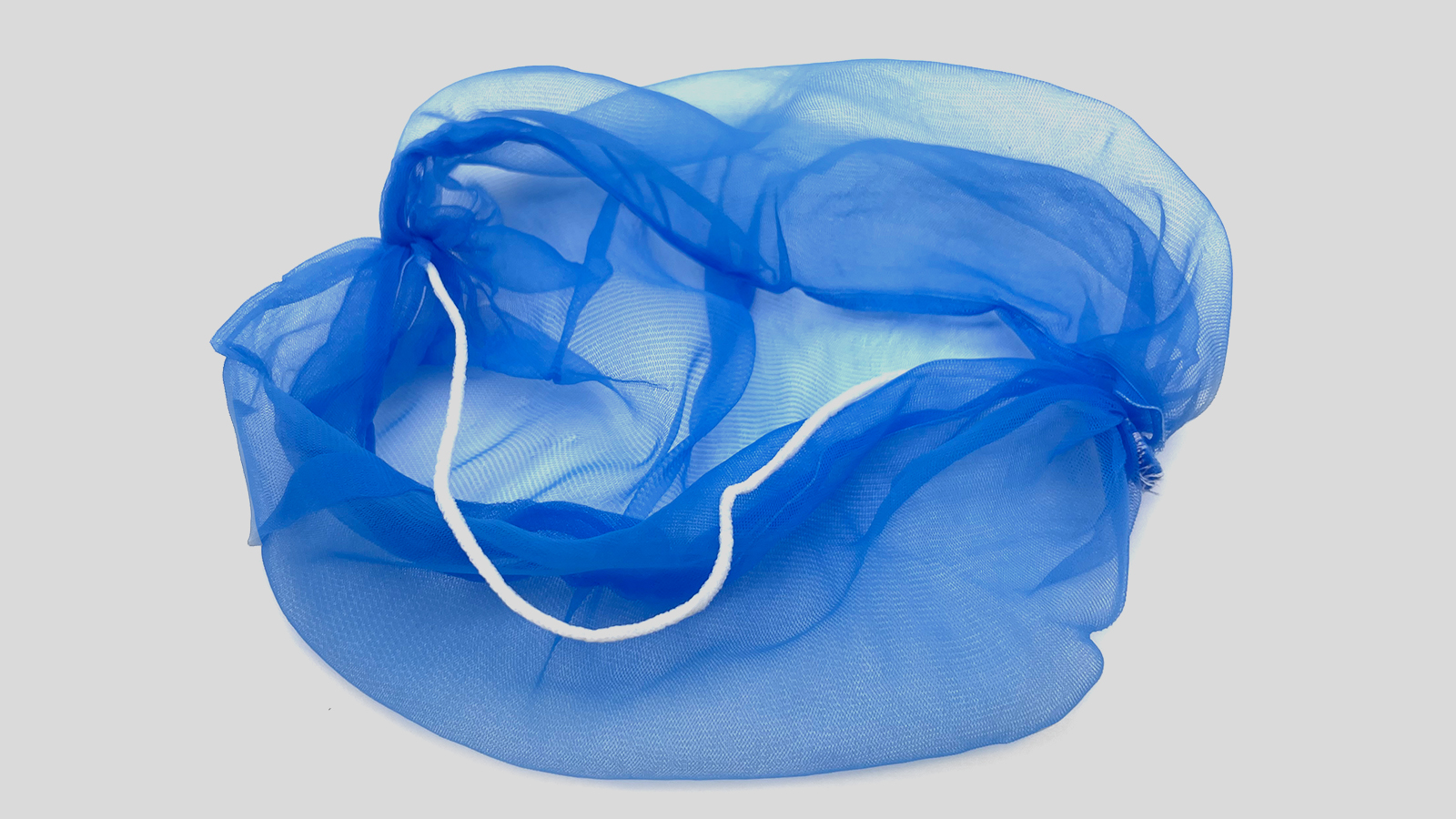
Depending on the working environment and hygiene requirements, there are different versions available:
- Standard beard masks made of non-woven polypropylene: lightweight, breathable, and suitable for daily use in food and healthcare environments.
- Spiral-folded or dispenser-compatible models: easy to handle in busy production areas.
- Detectable beard masks with a metal strip: mandatory in food-processing industries where detection systems are used.
- XXL variants: offer extra space and comfort for employees with longer or fuller beards.
Beard masks fall under disposable PPE and are designed for single use. All models are latex-free and meet the requirements for food safety and personal hygiene (food grade).
How to wear a beard mask correctly
Correct use determines its effectiveness. A poorly fitting beard mask can still allow hairs to escape or feel uncomfortable. Follow these steps carefully:
- Wash or disinfect your hands before touching the mask.
- Hold the mask by the elastic bands and open it until the full beard can be covered.
- Place the elastic bands behind the ears or around the head, depending on the model.
- Make sure the mask covers the entire chin, jawline, and moustache.
- Avoid touching the mask while wearing it.
- Remove the mask by only holding the elastic bands — do not touch the front.
- Use the beard mask only once and replace it if it becomes damp, dirty, or damaged.
The purpose of a beard mask
A beard mask — also called a beard net or beard cover — is designed to fully cover facial hair. In the food industry, but also in manufacturing companies, laboratories, and healthcare facilities, its use is mandatory based on company rules, HACCP requirements, and applicable audit standards.
According to NVWA guidelines for working according to the HACCP system, covering beard and moustache hairs is an essential part of hygienic and food-safe working. This prevents loose hairs, skin flakes, or bacteria from entering the production process.
In addition, a beard mask reduces the risk of indirect contamination through contact, for example when someone rubs their hands along their beard and then touches a surface or product.
Common mistakes
In practice, things often go wrong because the beard mask is worn under the chin, the moustache is not fully covered, or the same mask is used multiple times. Wearing a beard mask without a hairnet also occurs. These mistakes reduce hygiene effectiveness and increase the risk of contamination.
Proper storage of beard masks
Always store beard masks in a clean, dry dispenser or in sealed packaging, so they remain protected from dust and environmental contamination. Open storage in production areas or walkways increases the risk of contamination and should be avoided.
By placing dispensers strategically near changing rooms or at the entrance to production areas, employees have easy access to clean beard masks at the right time. Only use masks from reliable sources, with food grade certification, and made from latex-free materials.
Hygiene and personal protection
The beard mask is part of a broader hygiene protocol. In many companies, employees combine the beard mask with other personal protective equipment (PPE), such as hairnets, overshoes, disposable coveralls, and face masks. Together, these form an effective barrier against cross-contamination.
These measures align with the international HACCP principles, as established in the Codex Alimentarius of the World Health Organization (WHO). These guidelines serve worldwide as the basis for food safety systems. By instructing employees and checking regularly, the chance of cross-contamination remains minimal.
Popular beard masks

Advice from a PPE expert
Want to be sure your organisation meets the strictest hygiene requirements? Our PPE specialists advise daily on suitable beard masks, hairnets, and other hygienic clothing for the food industry, pharmaceutical sector, and healthcare institutions.
Neem gerust contact op voor persoonlijk advies of een vrijblijvende offerte via info@safetyproducts.com of +31 (0)314 757 300.
You might also like

EN 14404:2024 updated standard for knee protection
What does this mean in practice? In many professions, knee protection is essential, especially where prolonged kneeling...

New rules for allergen labelling from January 2026
Allergen warnings must be better substantiated From 1 January 2026, new rules for allergen labelling will come into forc...

Allergen Management in the Food Industry
Managing allergens in daily food production Allergens are a distinct risk within food safety. Unlike microbial risks, ev...

FSSC 22000 Certification
The globally recognised standard for food safety management FSSC 22000 (Food Safety System Certification) supports organ...
Detectable versus Non-Detectable
Why are detectable products relevant in production environments? On a production line, a broken pen or a lost plaster ca...

African Swine Fever (ASF): Reducing the Risk of Infection
The Human Factor Makes Farms Vulnerable – Hygiene and PPE Are Critical for Prevention African Swine Fever (ASF) contin...
Avian Influenza H5N1: Risks, Prevention and PPE
Practical Hygiene and PPE Measures for Work Involving Poultry Avian influenza, including the H5N1 virus, is a recurring...

IFS Food: International Standard for Food Safety
IFS Food and the Requirement for Waterproof Plasters IFS Food is one of the most widely recognized food safety standards...

Nitrile gloves – food grade
High-quality disposable nitrile gloves Disposable blue nitrile gloves are nowadays the standard in the food industry, th...
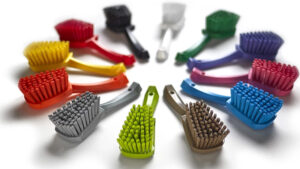
Colour coding for food safety in the food industry
Prevent cross-contamination with clear colour zones Colour coding in the food industry is a simple principle with substa...
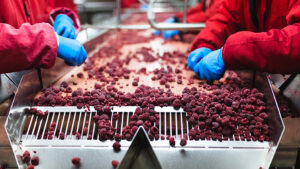
Why Blue Is Commonly Used in Food Production Environments
Visibility and Detectability of Blue Products in Food Processing In food production, colour is not a design choice. It s...

Safe Use of Disposables and PPE in the Cheese Industry
Essential Guidelines for Hygiene and Food Safety in Cheese Production Cheese production takes place in an environment wh...