Nipah virus and PPE in infection prevention
Rare, but with major impact on infection prevention and PPE use.
Recent reports of Nipah in India show how quickly a local outbreak can lead to additional isolation measures in healthcare facilities. The Nipah virus is a rare zoonosis, meaning it can spread from animals to humans. In some cases it causes encephalitis or severe respiratory symptoms. For hospitals and laboratories, this mainly means rapidly scaling up isolation measures. The right personal protective equipment (PPE) and hygiene products play an important role in this.

What is the Nipah virus?
The Nipah virus is a potentially deadly infectious disease that can cause a wide range of symptoms in humans, from mild complaints to severe respiratory infections and encephalitis. WHO classifies Nipah as a high-risk pathogen. Research with live virus may only take place in laboratories with the highest biosafety level (BSL-4).
In previous outbreaks, transmission within hospitals was a key concern, for example during care of patients in isolation or during intensive procedures such as ventilation. Natural reservoirs are mainly fruit bats, but infection through pigs or contaminated food is also possible. Within healthcare facilities, infection prevention teams determine which measures are required.
In humans, infection may be mild, but in severe cases encephalitis or a serious respiratory infection develops. According to WHO, the fatality rate ranges between 40 and 75 percent (WHO, accessed January 2026). At present, there is no vaccine or specific treatment available.
Transmission risks in healthcare settings
Nipah outbreaks are rare but require extra alertness within healthcare facilities. Infection through animals or contaminated food is also possible, but in healthcare environments the focus is mainly on isolation care and strict hand hygiene.
The main points of attention are:
- Hygiene and cleaning
Regular hand hygiene and thorough cleaning of contact surfaces remain a basic measure, especially in isolation rooms. - Clear procedures and documentation
Infection prevention requires clear agreements, such as isolation protocols, contact registration and staff instructions. - Correct use of PPE
In healthcare facilities, gloves, respiratory protection and isolation clothing are essential to limit transmission during intensive patient contact.
Infection prevention in healthcare facilities and laboratories
Nipah outbreaks are rare but require extra alertness within healthcare settings. In hospitals and clinics with isolation procedures, intensive patient contact can lead to transmission. Laboratories and diagnostic centers working with patient material must also know which protective measures are appropriate. In regions where outbreaks occur, the same applies to healthcare organizations that need to scale up infection prevention quickly.
In the fact sheet on the Nipah virus, WHO advises that patients with suspected or confirmed Nipah infection should preferably be cared for in a single-patient isolation room. Healthcare workers use contact and droplet precautions, such as a well-fitting mask, eye protection, a fluid-resistant gown and gloves.
During aerosol-generating procedures, additional airborne precautions may be required, including respiratory protection at FFP level. Visitors and caregivers should follow similar precautions according to protocol.
PPE and hygiene products for Nipah isolation
In suspected Nipah cases, protective measures are determined based on hospital protocols and guidelines from health authorities.
Usually this involves the following product categories:
- Gloves
- Respiratory protection
- Eye protection
- Isolation clothing, such as disposable coveralls, depending on protocol
- Hand disinfection
These are general product categories. The risk assessment and infection prevention policy of the institution determine which measures are used. Hospitals follow the guidelines of WHO and national health authorities.
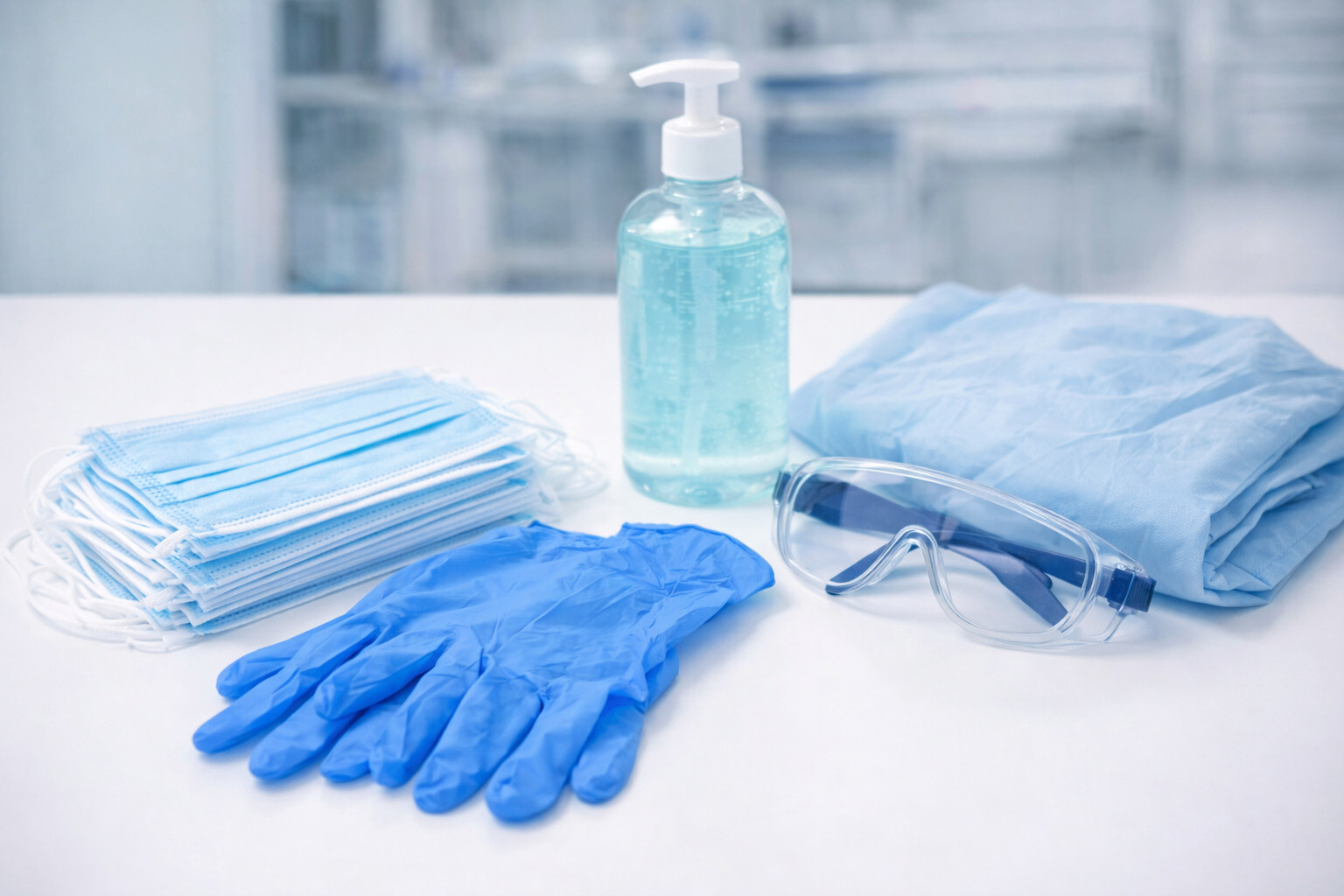
Popular PPE for infection prevention
How to implement infection prevention measures for Nipah
To keep the risk of infection with Nipah as low as possible, it is important to organize infection prevention in a practical and demonstrable way. These are the core measures:
- Voer een actuele risicoanalyse uit bij verdenking van zoönosen
- Train medewerkers in correct gebruik van PBM
- Gebruik disposable kleding in isolatiezones
- Leg procedures vast voor isolatie, contactonderzoek en bronopsporing
- Zorg voor voldoende voorraad handschoenen en maskers
- Registreer afwijkingen en incidenten in het kwaliteitssysteem
- Controleer reiniging en desinfectie aantoonbaar
Current guidelines and protocols
Recommendations for personal protective equipment (PPE) may also be reviewed and adjusted as more information becomes available about an outbreak. Therefore, always consult the current protocols of your own institution and official sources, such as the NCID/MOH Guidance on Nipah Virus.
When are FFP3 masks needed?
During procedures where aerosols may be generated (such as intubation), respiratory protection at FFP3 level may be necessary. In such situations, healthcare workers use respiratory protection during ventilation or other intensive procedures where close contact is unavoidable. Which type is applied (with or without exhalation valve) depends on the institution’s infection prevention protocol.
Popular FFP3 masks in our assortment include:

Advice from a PPE specialist
Do you want to be sure that your organization is well prepared for infection risks such as the Nipah virus? Then it is important that protective measures are not only available, but also demonstrably well embedded within the organization.
Our specialists are happy to advise on the choice of suitable PPE and hygiene products, tailored to the working environment and applicable guidelines. We also focus on practical usability, inventory management and substantiation for audits and inspections.
Feel free to contact us via info@safetyproducts.com or call +31 (0)314 757 300.
You might also like

EN 14404:2024 updated standard for knee protection
What does this mean in practice? In many professions, knee protection is essential, especially where prolonged kneeling...

New rules for allergen labelling from January 2026
Allergen warnings must be better substantiated From 1 January 2026, new rules for allergen labelling will come into forc...

Allergen Management in the Food Industry
Managing allergens in daily food production Allergens are a distinct risk within food safety. Unlike microbial risks, ev...

FSSC 22000 Certification
The globally recognised standard for food safety management FSSC 22000 (Food Safety System Certification) supports organ...
Detectable versus Non-Detectable
Why are detectable products relevant in production environments? On a production line, a broken pen or a lost plaster ca...

African Swine Fever (ASF): Reducing the Risk of Infection
The Human Factor Makes Farms Vulnerable – Hygiene and PPE Are Critical for Prevention African Swine Fever (ASF) contin...
Avian Influenza H5N1: Risks, Prevention and PPE
Practical Hygiene and PPE Measures for Work Involving Poultry Avian influenza, including the H5N1 virus, is a recurring...
IFS Food: International Standard for Food Safety
IFS Food and the Requirement for Waterproof Plasters IFS Food is one of the most widely recognized food safety standards...

Nitrile gloves – food grade
High-quality disposable nitrile gloves Disposable blue nitrile gloves are nowadays the standard in the food industry, th...
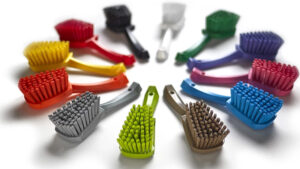
Colour coding for food safety in the food industry
Prevent cross-contamination with clear colour zones Colour coding in the food industry is a simple principle with substa...
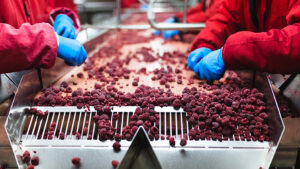
Why Blue Is Commonly Used in Food Production Environments
Visibility and Detectability of Blue Products in Food Processing In food production, colour is not a design choice. It s...

Safe Use of Disposables and PPE in the Cheese Industry
Essential Guidelines for Hygiene and Food Safety in Cheese Production Cheese production takes place in an environment wh...